Key findings
- There is no evidence that human attention span has shrunk to 8 seconds. The figure came from a 2015 Microsoft Canada marketing report that credited a website called Statistic Brain; no study behind it has been found. Still, 50% of UK adults believe it (King’s College London, 2021 survey).
- What has changed is how often we switch. Gloria Mark’s workplace studies found people stayed on one screen about 2.5 minutes in 2003 and about 47 seconds in 2016–2020. That measures habits, not brain capacity.
- Short-form video is linked to weaker attention, but not proven to cause it. A 2025 meta-analysis of 71 studies (98,299 people) found r = −0.38 for attention and −0.41 for inhibitory control. Most studies were cross-sectional.
- Distraction in class has a measurable cost. In PISA 2022, students distracted by classmates’ devices scored 15 points lower in math (OECD average). In a 2013 experiment, students in view of a laptop multitasker scored 17% lower.
- The fixed “10-minute lecture limit” is also weak. A 2016 review found no primary data for it; teacher differences mattered more than format. Chunking and breaks still help, for other reasons.
Short answer: students’ attention span has not collapsed to 8 seconds, and no study shows that it has. The famous figure comes from a 2015 marketing report with no traceable research behind it. What the evidence does show is narrower and more useful: people switch between screens far more often than 20 years ago, phones deliver hundreds of interruptions a day, and heavy short-form video use is linked (not proven to lead) to weaker attention. For teachers and parents, the practical goal is to cut switching, not to fight a mythical shrinking brain.
This page traces the myth, lays out what researchers actually measure, and turns the findings into classroom and homework routines. Every number has its source next to it.
Myth vs evidence at a glance
| Popular claim | What the evidence says | Source |
|---|---|---|
| “Humans now have an 8-second attention span” | No study behind the figure; it appeared in a 2015 Microsoft Canada report crediting the website Statistic Brain | BBC More or Less (2017); King’s College London (2022) |
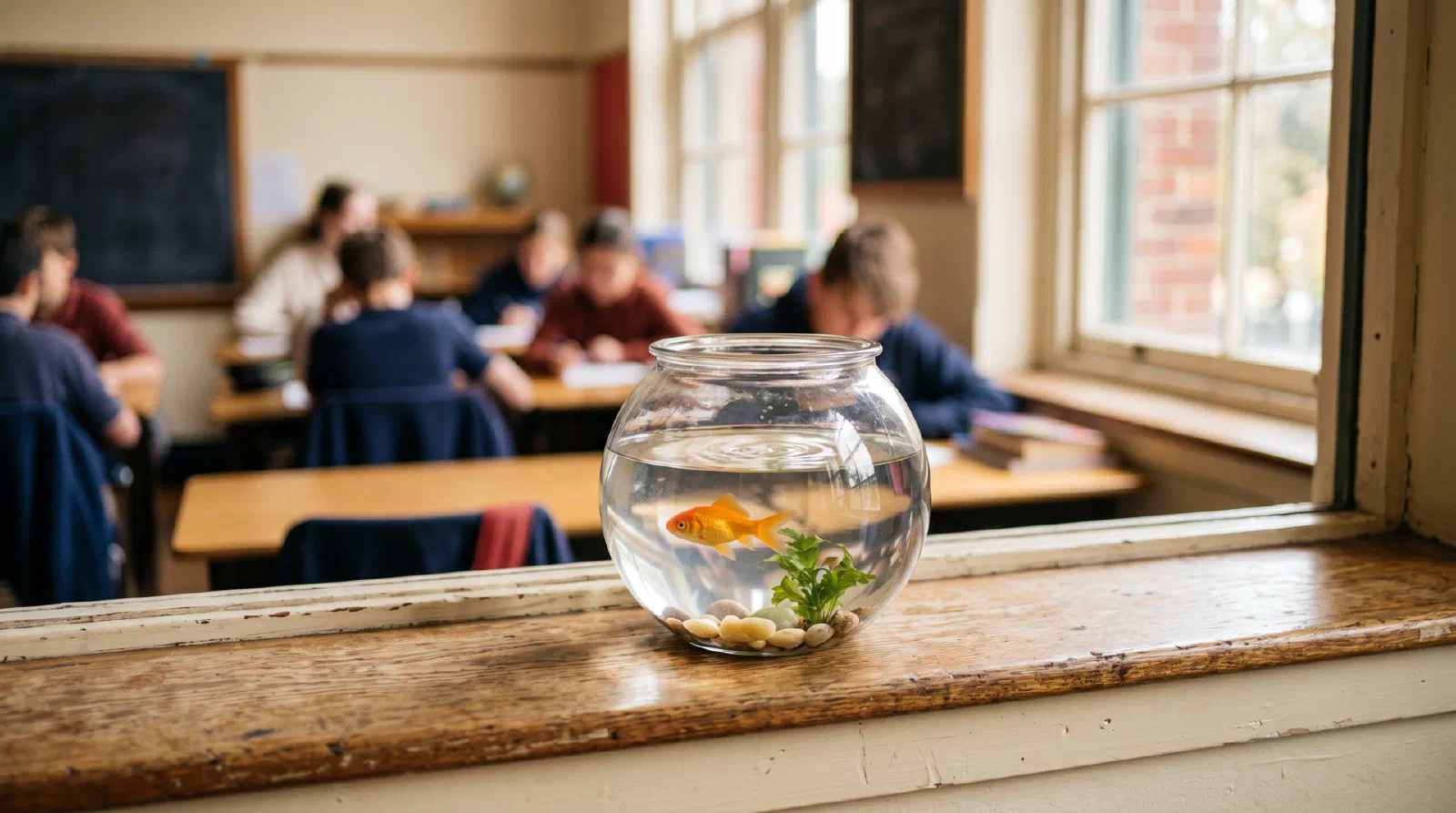
| “Goldfish (9 s) beat us” | No traceable goldfish experiment either | BBC More or Less (2017) |
| “Attention span has fallen from 12 to 8 seconds” | Lab measures of attention have been described as “remarkably stable across decades” | Edward Vogel, University of Chicago, WSJ (2017) |
| “We now focus for only 47 seconds” | True for one measure: average time on one screen at work before switching (2016–2020), down from about 2.5 minutes in 2003 | Gloria Mark, UC Irvine |
| “Students can only focus 10–15 minutes in a lecture” | No primary data support a fixed limit; teacher differences matter most | Bradbury (2016) |
| “TikTok destroys attention” | Moderate negative correlation (r = −0.38); cause not established | Nguyen et al., Psychological Bulletin (2025) |
| “A phone on the desk drains brainpower” | Contested: two direct replications failed, one meta-analysis supported it | FORRT replication atlas; University of Augsburg (2023) |
Table 1. Common attention-span claims and what the research shows.
Where the 8-second goldfish statistic came from
The figure traces to page six of a 2015 report by Microsoft Canada’s consumer insights team, which credited “Statistic Brain” as its source. The graphic showed an average human attention span of 12 seconds in 2000, 8 seconds in 2013, and 9 seconds for a goldfish. The report’s own research was a survey of about 2,000 Canadians plus brain-activity measurements of 112 people, and it was about multi-screen habits, not a time-in-seconds measure.
When the BBC’s statistics program More or Less checked the claim in 2017, reporter Simon Maybin followed each source listed by Statistic Brain and found no research supporting the numbers. Statistic Brain did not provide any. The goldfish comparison had no traceable experiment behind it either.
The myth has outlived the debunking. In a September 2021 survey of 2,093 UK adults for the King’s College London Policy Institute, 50% said the 8-second claim was true and only 25% correctly said it was false. Two-thirds (66%) thought young people’s attention spans were worse than in the past.
Source: King's College London Policy Institute, "Do we have your attention?" (2022), survey of 2,093 UK adults, 24–26 September 2021. Bars scaled to 100%.
What researchers actually measure when they study attention
“Attention span” is not one thing, so no single number can describe it. Psychologists separate several abilities, and each is measured differently.
| Ability | What it means | Typical measure | What studies show |
|---|---|---|---|
| Sustained attention | Keeping focus on one task over time | Long, boring lab tasks (vigilance tests) | Performance naturally dips with time on task; no evidence of a population-wide collapse |
| Selective attention and filtering | Ignoring irrelevant input | Tasks with distractors | Distractions such as nearby screens lower test scores |
| Inhibitory control | Stopping an automatic response | Go/no-go and similar tests | Most strongly linked to heavy short-video use (r = −0.41) |
| Task switching | Moving between tasks | Screen logs, switch-cost tests | People switch screens far more often than in 2003 |
Table 2. Components of attention and how they are measured.
The distinction matters because headlines blur them. A student who switches apps every 47 seconds may still be able to concentrate on a novel or a match for an hour. Michael Posner, a pioneer of attention research, told The Wall Street Journal in 2017 there was “no real evidence” attention had changed since it was first studied in the late 1800s. What has changed is the environment competing for it.
Is attention on screens getting shorter?
Yes, by one specific measure: how long people stay on a single screen before switching. Gloria Mark, professor emerita of informatics at UC Irvine and author of Attention Span, has logged computer use in workplaces since 2003. In her first study (published 2004), people averaged about two and a half minutes on one screen. In studies from 2016 to 2020, the average was 47 seconds, a finding other researchers have replicated, according to a University of California summary of her work.
Source: Gloria Mark's research, as summarized by the University of California (2024). Adult knowledge workers, not students. Bars scaled to 150 seconds.
Two limits apply. These were mostly adults at work, not schoolchildren, and the measure counts switches, which can be driven by notifications, job demands or habit. It shows that our days are more fragmented, not that our brains can no longer concentrate. Mark’s own advice focuses on habits: keep goals visible, single-task, and take breaks before exhaustion.
How much do phones interrupt students?
A lot: in one tracking study, teens received a median of 237 notifications a day, about a quarter during school hours. Common Sense Media and the University of Michigan’s C.S. Mott Children’s Hospital tracked 203 Android users aged 11 to 17 for a week for their 2023 “Constant Companion” report, as summarized by WebMD.
| Finding | Value | Source |
|---|---|---|
| Median notifications per day (ages 11–17) | 237 or more | Common Sense / U. Michigan, 2023 |
| Share arriving during school hours | about 23% | Same study |
| Phone use during the school day | median 43 minutes | Same study |
| Teens who find it hard to stop using devices | more than 66% | Same study |
| US teens online “almost constantly” | nearly half (24% a decade earlier) | Pew Research Center, Dec. 2024 |
| Teens on TikTok / YouTube almost constantly | 16% / 15% | Pew Research Center, Dec. 2024 |
| High school teachers: phones a major problem | 72% | Pew Research Center, 2024 |
Table 3. Teen phone use and interruptions. The Common Sense sample is small (203 teens) and Android-only.
Every notification is a potential switch. Even when a student does not open it, the urge to check competes with the task. This is the part of the attention debate with the clearest practical answer: fewer pings, fewer switches.
What the short-form video meta-analysis found
The largest review to date links heavier short-form video use with weaker attention, but it cannot show cause. Nguyen and colleagues pooled 71 studies with 98,299 participants in Psychological Bulletin (2025). Higher use of TikTok, Instagram Reels and similar formats correlated with poorer overall cognition (r = −0.34), with the strongest links for attention and inhibitory control.
Source: Nguyen et al. (2025), Psychological Bulletin 151(9), 1125–1146, doi:10.1037/bul0000498. Negative r means more use goes with poorer outcomes. Bars scaled to r = 0.5.
Read these numbers carefully. Most included studies were cross-sectional snapshots, so students who already struggle with attention or anxiety may be drawn to endless feeds. One critique notes the attention estimate rests on 14 studies, all conducted in China. Few studies separated short video from general social media use. Coverage of the review also reported that compulsive use mattered more than total minutes. The fair summary: a real warning sign, not proof of damage.
Do distractions in class actually lower scores?
Yes. This is where the evidence is most direct, because some of it is experimental. In a 2013 study in Computers & Education, Faria Sana, Tina Weston and Nicholas Cepeda had students take notes during a lecture. Those randomly assigned to multitask on a laptop scored 11% lower on a comprehension test, and students who simply sat in view of a multitasking peer scored 17% lower, as summarized by Simon Fraser University.
International data point the same way. In PISA 2022, about two-thirds of US 15-year-olds said they were distracted by their own digital devices in at least some math lessons (OECD average 65%), and across the OECD, students distracted by classmates’ devices scored 15 points lower in math, Education Week reported. PISA 2025 reading results fell 14 points in the US, matching the OECD average decline, and the OECD noted more “hasty readers” and signs of lower persistence on difficult tasks. PISA cannot establish cause.
US school leaders feel it too: in May 2024, 26% of public schools said lack of focus or inattention had a severe negative impact on learning (NCES). See our analysis of what teachers report about behavior and absences for the wider picture.
What this means for lessons: chunking, breaks and timers
Design lessons to reduce switching costs and fatigue, not to fit an imaginary 8-second window. Neil Bradbury’s 2016 review in Advances in Physiology Education found the popular 10-to-15-minute lecture limit rests on weak sources, and that differences between teachers explained more variation in attention than the format (PubMed). Chunking still helps, because varied activity manages fatigue and gives students a reason to re-engage.
| If you see this | Likely cause | Try this |
|---|---|---|
| Attention drops midway through a long explanation | Fatigue, passive listening | Break into 10–15 minute segments, each ending with a quick question or task |
| Restlessness after a long seated block | Need for movement | A 3–5 minute active break; a 2018 review found classroom behavior improved after short intense or longer moderate breaks in 9 of 11 interventions |
| Students lose track of time on independent work | No visible structure | Show a countdown, such as a 10-minute classroom timer |
| Phones pulling focus | Notifications | Phones away and silenced during work blocks; enforce the school policy consistently |
| Noise creeping up during group work | No shared signal | A visible classroom noise meter |
Table 4. Classroom symptom, likely cause and a practical response.
For ready-made activities, our list of brain breaks for the classroom includes movement and calm-down options with a random picker. Pair each work block with the full-screen classroom timer, or use the 5-minute timer for breaks so they end on time. More tools for structuring a lesson are on our for teachers hub.
What this means for homework and studying
At home, the biggest gain comes from removing interruptions before starting. These steps follow the evidence above, in order.
- Phone in another room, notifications off. With a median of 237 notifications a day in the Common Sense study, this one step removes the main source of switching.
- Work in timed blocks. Try 20 to 25 minutes of single-task work, then a 5-minute break. Our homework motivation guide includes a built-in focus timer.
- Set one goal per block. Gloria Mark recommends keeping goals visible, for example on a sticky note.
- Use active study methods. Retrieval practice and spaced review keep attention engaged better than rereading; see study methods ranked by research, or the two-week plan for studying for finals for longer review stretches.
- Keep the total load reasonable. Long, unbroken homework sessions invite drift. Check typical nightly time for each grade with the homework time calculator, and spread big tasks over the week with the homework planner.
Worked example. A ninth grader with 90 minutes of homework could plan three 25-minute blocks with two 5-minute breaks (25 × 3 + 5 × 2 = 85 minutes), leaving 5 minutes to pack up. With the phone away, that is three switching-free stretches instead of dozens of interrupted ones.
Methodology and limitations
We reviewed published studies and surveys; we ran no experiments. Sources were checked on October 15, 2026.
- The myth’s origin is documented mostly through secondary accounts of the BBC’s 2017 investigation and the King’s College London report; we could not open the BBC page itself.
- Gloria Mark’s data come from adult knowledge workers, not students.
- The meta-analysis is correlational; the attention estimate rests on a small, geographically narrow set of studies.
- Constant Companion tracked 203 Android users for one week; the “43 minutes” figure is reported as a median in some coverage and an average in others.
- PISA shows associations between distraction and scores across countries, not cause.
- No dataset we found measures children’s sustained-attention capacity over decades, so no one can say with data that it has fallen.
Cite this page
Sources
- King’s College London Policy Institute, “Are attention spans really collapsing?” and report “Do we have your attention?” (2022): kcl.ac.uk ; report page
- University of California, “How to sharpen your attention and meet your goals” (Gloria Mark), 2024: universityofcalifornia.edu
- Nguyen, L. et al. (2025). Feeds, feelings, and focus: A systematic review and meta-analysis examining the cognitive and mental health correlates of short-form video use. Psychological Bulletin 151(9), 1125–1146: doi.org
- Bradbury, N. A. (2016). Attention span during lectures: 8 seconds, 10 minutes, or more? Advances in Physiology Education 40(4), 509–513: pubmed.ncbi.nlm.nih.gov
- Sana, F., Weston, T. & Cepeda, N. J. (2013). Laptop multitasking hinders classroom learning for both users and nearby peers. Computers & Education 62, 24–31. Summary: sfu.ca
- Common Sense Media and University of Michigan, “Constant Companion” (2023), via WebMD: webmd.com
- Pew Research Center, “Teens, Social Media and Technology 2024”: pewresearch.org ; “72% of U.S. high school teachers say cellphone distraction is a major problem” (2024): pewresearch.org
- Education Week on PISA 2022 digital distraction (Dec. 2023) and PISA 2025 reading (Sept. 2026): edweek.org ; edweek.org
- NCES School Pulse Panel press release, July 18, 2024: nces.ed.gov
- Daly-Smith, A. et al. (2018). Systematic review of acute physically active learning and classroom movement breaks. BMJ Open Sport & Exercise Medicine: doaj.org
- Phone “brain drain” replications: FORRT replication atlas, forrt.org ; University of Augsburg meta-analysis (2023), uni-augsburg.de
Checked October 15, 2026. Spot an error? Tell us and we will correct it.
Frequently asked questions
What is the average attention span of a student?
Is the 8-second attention span true?
Does TikTok shorten attention span?
How long can students focus in class?
Are phones making students less focused?
How can students improve their focus for studying?
Watch: video explainers
A short animated explainer from neuroscientist Shannon Odell on how attention works and how to protect it. Pair it with the research summary on this page.
A news report on the PISA 2025 reading decline and the screen-time debate. The data section here explains what PISA can and cannot show about cause.
Videos are hosted by YouTube and load only when you press play (privacy-enhanced mode). We are not affiliated with these channels.