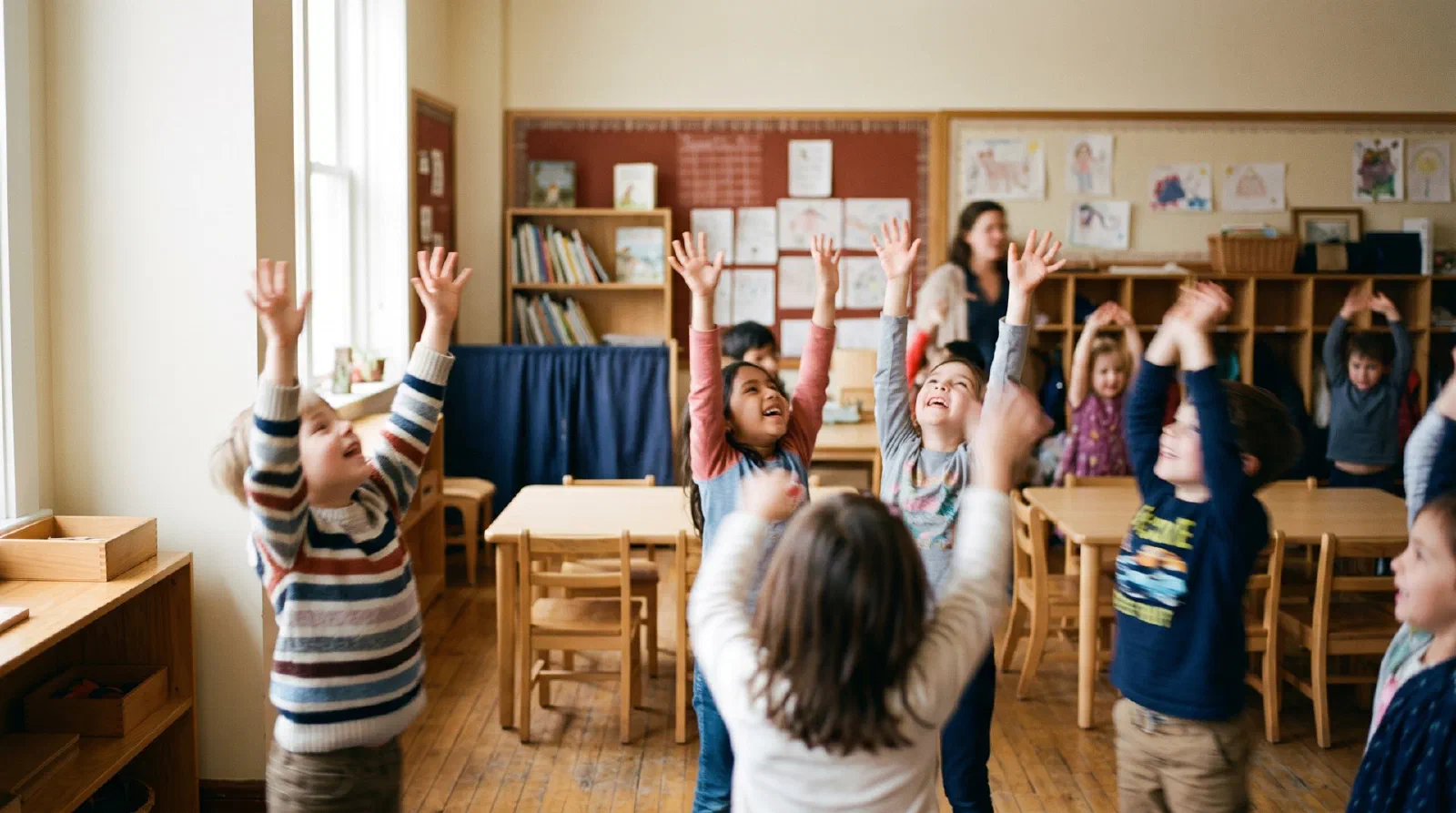
The short answer
- A brain break is a planned 1 to 5 minute pause, usually with movement or calm breathing, that resets attention before students return to work. This page lists 60 of them with grade band, space and noise level, and a picker that chooses one for you.
- Evidence: a 2017 meta-analysis of classroom physical activity in elementary schools found a moderate improvement in on-task behavior afterward (standardized mean difference 0.60), though the studies varied a lot.
- When: before attention fades, not after. A common rhythm is one break every 20 to 30 minutes of seated work, or between subjects.
- Match the break to the goal: movement to wake a sleepy room, calm breathing to settle an excited one, brain games to stay on content.
- Keep it short and routine: set a 2-minute timer, use the same signal to start and stop, and return straight to the task.
Brain breaks are short, planned pauses that reset a class before attention runs out. This page gives you 60 ideas, each 1 to 5 minutes long, with the grade band, the space it needs and how noisy it gets, so you can choose one in seconds. Or let the picker below choose for you.
Pick a brain break for your class
The picker filters the same 60 activities listed in the tables on this page. Choose how much time you have, the grade and the type, then press Pick one. It never picks the same activity twice in a row, and it works offline once the page has loaded.
What counts as a brain break?
A brain break is a deliberate pause in a lesson, short enough that it costs almost no teaching time and structured enough that students return ready to work. It is different from free time or recess: the teacher starts it, it has one clear activity, and it ends on a signal.
Brain breaks fall into four rough types, which is how the tables below are organized:
| Type | What it does | Best moment | Ideas on this page |
|---|---|---|---|
| Movement | Raises energy, gets blood moving | After long seated work, mid-afternoon slump | 18 |
| Calm | Lowers energy, settles the room | After recess or lunch, before a test | 14 |
| Brain games | Keeps minds on content with a twist | Between two parts of the same lesson | 16 |
| Social | Builds connection and community | Start of the day, Fridays, after group conflict | 12 |
Table: the four types of brain breaks and when each one fits.
The CDC defines classroom physical activity as any physical activity done in the classroom, and lists better focus, less fidgeting and disruptive behavior, and more engagement among the benefits schools report (CDC, classroom physical activity).
Do brain breaks work? What the research says
The best summary of the evidence is a 2017 systematic review and meta-analysis by Watson, Timperio, Brown, Best and Hesketh in the International Journal of Behavioral Nutrition and Physical Activity (full text). It reviewed 39 studies of classroom-based physical activity in elementary schools and pooled 16 of them. The pooled result for on-task behavior after activity breaks was a standardized mean difference of 0.60 (95% confidence interval 0.20 to 1.00), a moderate effect. Academic achievement improved only in studies that used a progress-monitoring tool, and the authors found no significant effect on cognitive functions such as executive function.
Two honest caveats. First, the studies varied widely in design and length, and the authors say this limits firm conclusions. Second, almost all the research is in elementary schools, so the case for middle and high school rests more on teacher experience than on trials. The practical reading: short activity breaks are a low-cost way to improve time on task, not a cure for a lesson that runs too long.
Movement brain breaks (18 ideas)
Movement breaks are the classic brain break: everyone stands, moves for a minute or two, and sits back down warmer and more alert. Most need only the space beside a desk. Mark High-noise ones for days when the class next door is not testing.
| Activity | How it works | Min | Grades | Space | Noise |
|---|---|---|---|---|---|
| Simon Says | The leader calls actions. Students move only when the command starts with “Simon says.” Anyone caught simply keeps playing; no one sits out. | 2 | K–5 | Beside desk | Medium |
| Freeze Dance | Play upbeat music. Everyone dances in place and freezes the moment it stops. Hold the freeze for three seconds before restarting. | 3 | K–5 | Beside desk | High |
| Four Corners | Number the corners 1 to 4. Students walk quietly to one. A caller with eyes closed names a number, and that corner earns a point. | 5 | K–5 | Open floor | Medium |
| Mirror Partners | Partners face each other. One leads slow movements and the other mirrors them exactly. Swap leaders after 45 seconds. | 2 | K–8 | Beside desk | Low |
| Count-Down Shake | Shake the right hand 8 times while counting aloud, then the left hand, right foot and left foot. Repeat with 7, 6 and so on down to 1. | 1 | K–5 | Beside desk | Medium |
| Desk Push-Ups | Place hands on the edge of a sturdy desk or the wall and do 10 slow push-ups. Rest and repeat once. | 1 | 3–12 | Beside desk | Low |
| Silent Lap | Students walk one lap of the room without making a sound, then return to their seats. Anyone who makes noise starts the lap again. | 1 | K–8 | Open floor | Low |
| Move Your Choice | Read two options aloud (cats or dogs, beach or mountains). Students step left for the first and right for the second. | 3 | K–12 | Beside desk | Medium |
| Skip-Count Jacks | Do jumping jacks while counting aloud by 2s, 5s or 10s. Change the counting rule every 20 seconds. | 2 | K–5 | Beside desk | High |
| Animal Moves | Call out an animal and students move like it in place: penguin waddle, flamingo stand, frog squat, bird flap. | 2 | K–2 | Beside desk | Medium |
| Balance Challenge | Stand on one foot for 30 seconds, switch feet, then try again with eyes closed. Keep a hand near a desk for safety. | 1 | K–12 | Beside desk | Low |
| Rock-Paper-Scissors Tournament | Students play a partner. The loser becomes the winner’s cheering section and follows them to the next match, until two finalists remain. | 3 | K–12 | Open floor | High |
| Stretch and Reach | Lead five stretches for five seconds each: reach high, side bends, shoulder rolls, gentle neck tilts, and touching toes. | 2 | K–12 | Beside desk | Low |
| True or False Squat | Read a statement from today’s lesson. Students stand tall for true and squat for false. Reveal the answer after each one. | 3 | 2–12 | Beside desk | Medium |
| Pass the Clap | Standing in a circle, students pass a single clap from person to person as fast as possible. Time each round and try to beat the record. | 2 | K–8 | Circle | Medium |
| Run-in-Place Sprints | Run in place as fast as possible for 20 seconds, then rest for 10. Repeat four times. | 2 | 3–12 | Beside desk | High |
| Body Spelling | Spell a vocabulary word letter by letter. Arms up for tall letters (b, d, h), hands on hips for short letters (a, c, e), touch toes for letters that dip (g, p, y). | 3 | 1–5 | Beside desk | Medium |
| Walk-and-Talk | Pairs walk to the end of the hallway and back while answering a discussion question from the lesson. | 5 | 6–12 | Hallway | Medium |
Table: 18 movement brain breaks with time, grade band, space and noise level.
Calm brain breaks (14 ideas)
Calm breaks do the opposite job: they bring a buzzing room down. They are the ones to use straight after recess, lunch or an assembly, and before a test. Almost all of them work at desks with the lights dimmed, and they are quiet enough for any time of day.
| Activity | How it works | Min | Grades | Space | Noise |
|---|---|---|---|---|---|
| Five-Finger Breathing | Hold up one hand. Trace up each finger with the other hand while breathing in and down while breathing out. Five slow breaths. | 1 | K–5 | At desk | Low |
| Box Breathing | Breathe in for 4 counts, hold for 4, breathe out for 4, hold for 4. Repeat four rounds while the teacher counts quietly. | 2 | 3–12 | At desk | Low |
| 5-4-3-2-1 Senses | Silently notice 5 things you see, 4 you hear, 3 you can feel, 2 you can smell and 1 you can taste. | 2 | 2–12 | At desk | Low |
| Seated Stretches | Seated twists to each side, wrist circles, ankle circles and slow shoulder shrugs, five of each. | 2 | K–12 | At desk | Low |
| Silent Ball | Students toss a soft ball around the room in silence. Talking or a wild throw means you sit down for the rest of the round. | 5 | 1–8 | Open floor | Low |
| Listening Minute | Lights off and eyes closed for 60 seconds. Afterward, students list every sound they noticed and compare with a partner. | 1 | K–12 | At desk | Low |
| Doodle Break | Two minutes of free doodling on scrap paper while quiet music plays. No talking, no rules about what to draw. | 2 | K–12 | At desk | Low |
| Squeeze and Release | Squeeze both fists tight for 5 seconds, then let go. Repeat with shoulders, face and legs. | 2 | 2–12 | At desk | Low |
| Balloon Breath | Hands on bellies. Breathe in slowly to blow up the balloon, then let the air out with a long, quiet hiss. | 1 | K–2 | At desk | Low |
| Three Good Things | Students write down three things that went well today, however small. Two volunteers can share one. | 2 | 3–12 | At desk | Low |
| Slow-Motion Statue | Move from sitting to standing in slow motion over about 30 seconds, freeze, then sit back down just as slowly. | 1 | K–8 | Beside desk | Low |
| Picture a Place | The teacher describes a calm place (a beach, a quiet forest) for about a minute while students picture it with eyes closed. | 2 | K–8 | At desk | Low |
| Far Look | Look out the window or across the room at the farthest point you can see for 20 seconds. Blink slowly and repeat three times. | 1 | 3–12 | At desk | Low |
| Class Hum | The class hums one note together for one long breath, then a lower note. Three rounds. | 1 | K–5 | At desk | Low |
Table: 14 calm brain breaks for settling a class.
Brain-game breaks (16 ideas)
Brain games keep students seated but switch the kind of thinking they are doing. Many of them can carry your content, which makes them the easiest breaks to justify on a tight schedule. Swap the example words and numbers for this week’s vocabulary or facts.
| Activity | How it works | Min | Grades | Space | Noise |
|---|---|---|---|---|---|
| Mental Math Chain | Say a chain aloud: start with 5, double it, add 3, take away 1. Students hold up the answer on fingers or a whiteboard. | 2 | 2–8 | At desk | Low |
| Category Race | Name a category and a letter (animals, B). Pairs list as many items as they can in 60 seconds. | 2 | 2–12 | At desk | Medium |
| Riddle Break | Read one riddle. Students whisper a guess to a partner before you reveal the answer. | 2 | 2–12 | At desk | Medium |
| Twenty Questions | Think of an object. The class asks up to 20 yes-or-no questions to work out what it is. | 5 | 2–12 | At desk | Medium |
| Odd One Out | Show four words, numbers or pictures. Students decide which one does not belong and explain why. More than one answer can be right. | 2 | 2–12 | At desk | Low |
| Word Ladder | Change one word into another one letter at a time, making a real word at each step: CAT, COT, DOT, DOG. | 3 | 3–12 | At desk | Low |
| Backwards Spelling | The class spells a word backwards aloud together, one letter at a time. Start with short words and build up. | 1 | 2–8 | At desk | Medium |
| Clap on Threes | Count around the room. On every multiple of 3, the student claps instead of saying the number. Switch to multiples of 4 for a challenge. | 3 | 2–8 | At desk | Medium |
| Draw It in 30 | Name an object. Students sketch it in 30 seconds, then hold up their drawings. Repeat with three objects. | 2 | K–12 | At desk | Low |
| Memory Tray | Show 10 objects or pictures for 30 seconds, then cover them. Students list as many as they can remember. | 3 | K–8 | At desk | Low |
| Alphabet Around | Go around the room naming an animal (or a country, or a food) for each letter from A to Z. | 3 | 2–12 | At desk | Medium |
| Estimation Station | Show a jar of objects or a crowded picture. Students write an estimate, then reveal the real count. | 2 | K–8 | At desk | Low |
| Two Truths and a Lie | The teacher or a student says three statements about themselves. The class votes on which one is the lie. | 5 | 3–12 | At desk | Medium |
| Finish the Pattern | Write a number or shape pattern on the board (2, 6, 18, …). The first student to explain the rule picks the next pattern. | 2 | 1–8 | At desk | Low |
| Opposite Actions | Call an action and students do the opposite: say stand and they sit, say look up and they look down. | 2 | K–5 | Beside desk | Medium |
| Vocabulary Sketch | One student draws a vocabulary word on the board without letters or numbers. The class guesses the word. | 5 | 2–12 | At desk | Medium |
Table: 16 brain-game breaks, most of which can use lesson content.
Social brain breaks (12 ideas)
Social breaks build the relationships that make the rest of classroom management easier. They take a little longer, so they fit well at the start of the day, at the end of the week, or after a group task that got tense.
| Activity | How it works | Min | Grades | Space | Noise |
|---|---|---|---|---|---|
| Compliment Circle | Each student gives a specific compliment to the person on their right, such as “You explained the fractions clearly.” | 5 | K–12 | Circle | Low |
| Find Someone Who | Give a list of prompts (has a pet, was born in another state, likes math). Students find a different classmate for each one. | 5 | 2–12 | Open floor | Medium |
| High-Five Recap | Find a partner, high-five, and tell them one thing you learned today. Repeat with two more partners. | 2 | K–8 | Open floor | Medium |
| This or That | Give two choices (pizza or tacos). Students point to one side and tell a neighbor one reason. | 2 | K–12 | At desk | Medium |
| Count to 20 | The class tries to count to 20 one voice at a time, in no set order. If two people speak at once, start over at 1. | 3 | 3–12 | At desk | Low |
| Back-to-Back Drawing | One partner describes a simple picture made of shapes. The other partner draws it without seeing it. Compare and swap. | 5 | 3–12 | At desk | Medium |
| Silent Birthday Line | Students line up in order of birthday (month and day) without talking, using only gestures. | 5 | 3–12 | Open floor | Low |
| Story Chain | Start a story with one sentence. Each student adds the next sentence until the story ends or the timer does. | 5 | K–12 | At desk | Medium |
| Mingle and Group | Students walk around the room. Call a number and they form groups of that size as fast as possible. | 3 | K–5 | Open floor | Medium |
| Thank-You Note | Each student writes a short thank-you note on a sticky note for a classmate and delivers it. | 3 | 2–12 | At desk | Low |
| Elbow Partner Interview | Partners take turns asking one question from a card (What would you invent? Best book this year?) and listening to the answer. | 2 | 2–12 | At desk | Medium |
| Thumbs Vote | Read opinions such as “Recess should be longer.” Students show thumbs up, down or sideways, then two volunteers explain. | 3 | 3–12 | At desk | Low |
Table: 12 social brain breaks that build class community.
Brain breaks by grade: first graders, fourth graders, middle schoolers
Brain breaks for first graders should be short, physical and full of imagination. Animal Moves, Skip-Count Jacks, Balloon Breath, Freeze Dance and Simon Says all work. Six-year-olds need very clear start and stop signals; a chime or a raised hand works better than your voice over the noise. Plan more breaks, not longer ones.
Brain breaks for fourth graders can add a challenge or a rule: Four Corners, Rock-Paper-Scissors Tournament, Clap on Threes, Body Spelling and Word Ladder. Fourth graders like keeping score and beating the class record, so time Pass the Clap and post the best time.
Brain breaks for middle schoolers need to avoid feeling babyish. Choice and competition help: Count to 20, Two Truths and a Lie, Walk-and-Talk, Box Breathing and the Silent Birthday Line. Let a student run the break, or offer two options and vote with the random name picker choosing the leader. High schoolers respond to the same approach, framed as a quick reset before the next task.
Math brain breaks and other academic breaks
Math brain breaks practice facts while students move or play, so the break pays for itself. The strongest ones from the tables:
- Skip-Count Jacks: counting by 2s, 5s or 10s with each jumping jack.
- Mental Math Chain: a running calculation students hold in their heads.
- Clap on Threes: multiples of 3 or 4, said or clapped around the room.
- Finish the Pattern: spotting the rule in a sequence.
- Estimation Station: a quick number-sense estimate with a reveal.
For other subjects, True or False Squat turns any set of review statements into a movement break, Body Spelling works with this week’s spelling list, and Vocabulary Sketch covers key terms in science or social studies. If you need groups for a partner break, the random group generator splits the class fairly in one click.
How to run a brain break without losing the class
The most common worry about brain breaks is that the room will not settle afterward. A few habits prevent that.
- Teach the routine once, properly. Practice the start signal, the activity and the return before you need it. A practiced routine is over in a couple of minutes; an unpracticed one drifts.
- Show the time. Put a visual classroom timer on the board so students can see the break is short. A 1-minute or 5-minute timer covers every activity here.
- End on a calm step. Finish a high-energy break with three slow breaths or the Slow-Motion Statue before work resumes.
- Return to a specific task. Tell students exactly what they will do next before the break starts.
- Watch the volume. If a break gets louder than you want, a classroom noise meter on the projector gives the class a visible target.
Symptom, cause and fix: when brain breaks go wrong
| Symptom | Likely cause | Fix |
|---|---|---|
| The class will not calm down afterward | High-energy break with no cool-down | End with a calm step; choose calm breaks after lunch |
| Students treat breaks as free time | No clear start and stop signal | Teach one signal; use a visible timer |
| Older students refuse to join | Activity feels childish | Offer a choice, add competition, let a student lead |
| Breaks eat too much time | Breaks too long or improvised | Pick from a short list; cap at 2 to 3 minutes |
| Same few students dominate | Activities reward the loudest | Use whole-class or partner formats; rotate leaders |
| A student cannot join the movement | Injury, disability or space | Offer a seated version of the same activity |
Table: common brain-break problems with causes and fixes.
Brain breaks are one tool among many. For routines, praise and the research behind them, see our guide to classroom management strategies. Planning around a holiday? The holiday brain breaks list has 45 seasonal versions with the same picker, and more free classroom tools are on the teacher tools page.