The short answer
- The classroom management strategies with the strongest evidence are changing the environment so problems are less likely, and explicitly teaching and reinforcing the behavior you want. The federal IES practice guide rates both “strong evidence.”
- Start with the why: note what happens right before and after a problem behavior; the pattern usually points to the fix.
- Expect modest, real gains: a 2025 meta-analysis of 76 controlled studies found an average effect of g = 0.23, and targeted programs beat ones that try to do everything.
- The everyday core: clear routines, a deliberate room layout, frequent specific praise, active supervision, fast transitions and contact with families.
- Free tools help with the mechanics: a visible classroom timer, a no-repeat random name picker, random groups and a seating chart.
Classroom management strategies are the routines, room arrangements and responses that keep students learning instead of drifting. The short version from the research: prevent problems by designing the environment, teach the behavior you want as deliberately as you teach content, and reinforce it often. Below are eight strategies with the evidence behind each, a symptom-to-fix table for common problems, and free classroom tools that take care of the mechanics.
What does the research say works?
The most practical summary is a federal one. The Institute of Education Sciences practice guide Reducing Behavior Problems in the Elementary School Classroom (Epstein and colleagues, 2008) reviewed the evidence and made five recommendations, each with a rating (IES What Works Clearinghouse):
| IES recommendation | Evidence rating |
|---|---|
| Identify the specifics of the problem behavior and what prompts and reinforces it | Moderate |
| Modify the classroom learning environment to decrease problem behavior | Strong |
| Teach and reinforce new skills to increase appropriate behavior | Strong |
| Draw on colleagues and families for guidance and support | Moderate |
| Assess whether schoolwide problems need schoolwide strategies | Moderate |
Table: the five recommendations of the IES practice guide on classroom behavior (2008) and their evidence ratings.
Newer research points the same way. Korpershoek, de Boer and Mouw’s 2025 update of their meta-analysis in the Review of Educational Research pooled 76 controlled studies of classroom management interventions in primary schools from 2003 to 2022. The average effect was small but significant (Hedges’ g = 0.23), and interventions that tried to cover every area at once did worse than targeted ones (University of Groningen record). The lesson for a busy teacher: pick a few strategies and do them consistently.
1. Teach routines like content
Most disruptions happen in the gaps: entering the room, handing in work, moving to groups, getting a pencil. A routine turns each gap into a known sequence. The IES guide’s “teach and reinforce new skills” recommendation applies here: explain the routine, model it, have students practice it, and give feedback, exactly as you would with a math procedure.
Choose five or six routines for the first weeks: the entry routine, the attention signal, handing in work, asking for help, transitions, and packing up. Practice each one until it runs without reminders, then re-teach after long breaks. Put the steps on a poster so the reminder can be a point instead of a speech.
The payoff is time. A transition that takes 45 seconds instead of 3 minutes, repeated six times a day, returns more than an hour a week (2.25 minutes × 6 transitions × 5 days = 67.5 minutes). A visible classroom timer helps students see how long the transition should take and makes beating the clock a game.
2. Arrange the room to prevent problems
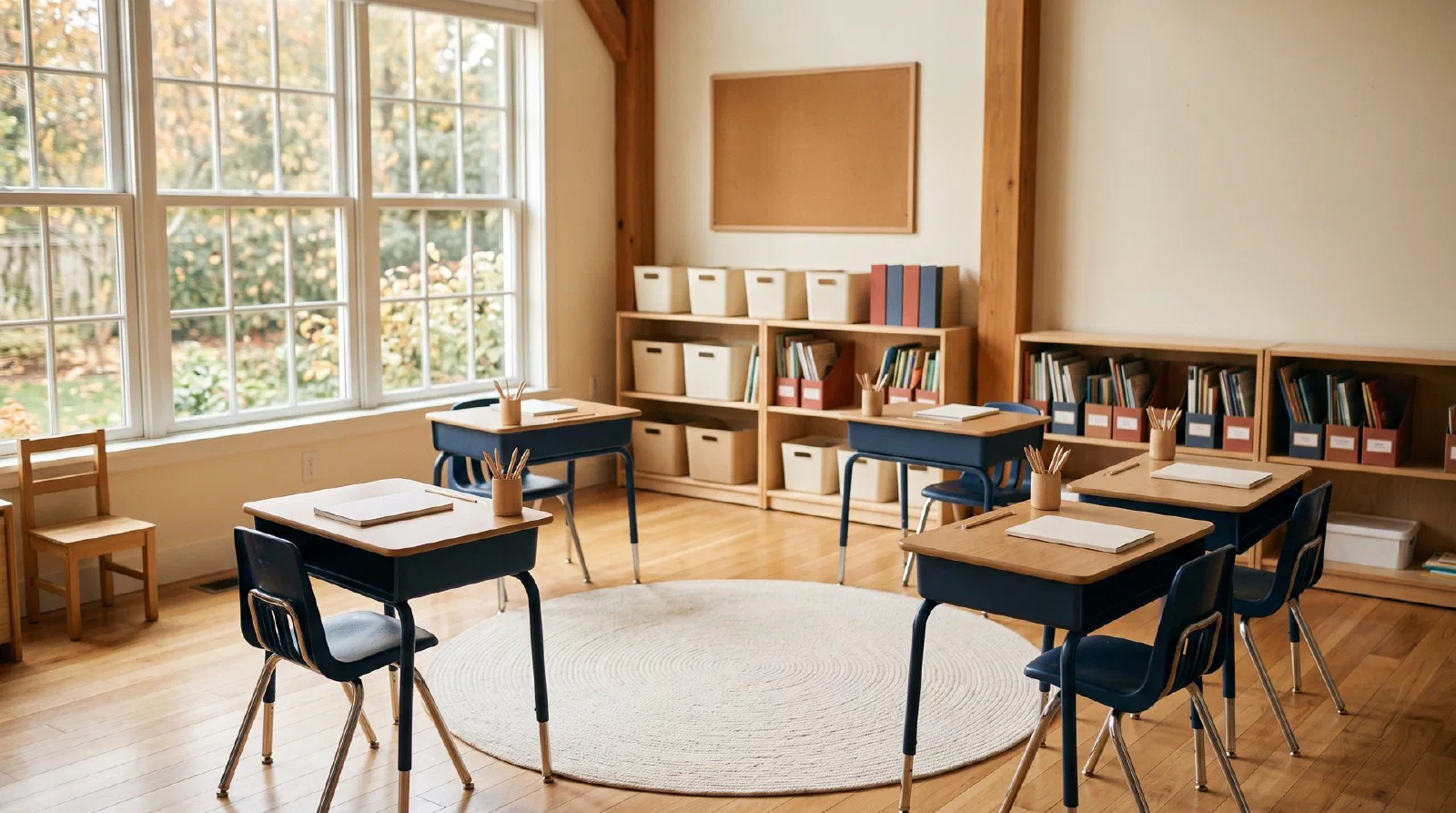
Changing the environment is one of the two IES recommendations with strong evidence, and it is the cheapest. Ask three questions about your room. Can you see every student from where you usually stand? Can you reach every desk in a few steps? Are the high-traffic spots (pencil sharpener, door, supplies) away from students who are easily distracted?
Seating is the most powerful lever. Rows suit independent work and tests; pairs or clusters suit discussion. Move students who distract each other apart, and seat students who need support close to where you teach. Plan it on paper, or with the free seating chart maker, which keeps names on your device and lets you shuffle and print in a minute.
Small environmental fixes add up: materials ready before students arrive, clear labels on supply areas, and the day’s agenda on the board so nobody needs to ask what is next.
3. Praise specific behavior, often
Reinforcement is the other half of the IES “teach and reinforce” recommendation. The useful kind is behavior-specific praise: naming exactly what the student did. “Table 3 started the warm-up within a minute” teaches more than “good job,” because it tells the whole class what you want to see.
Aim for far more positive comments than corrections, and spread them across the room rather than reserving them for the same few students. Praise can be quiet: a note on a desk, a thumbs-up, a positive call home. For a class-wide incentive, a homework pass or a few minutes of choice time costs little.
Praise loses value when it is constant and vague, or when it only follows misbehavior that stopped. Tie it to the routines you are teaching, and fade it gradually once a routine is solid.
4. Find out why the behavior happens
The first IES recommendation is to identify the specifics: when the behavior happens, what comes right before it, and what follows. Teachers often call this the ABC pattern (antecedent, behavior, consequence). A week of quick notes usually reveals something you can change.
If a student acts out every time independent writing starts, the trigger may be the task, and the payoff may be escaping it by being sent out. Sending the student out then rewards the behavior. A better fix targets the trigger: a shorter first step, a sentence starter, or a check-in two minutes after the start.
Look for patterns at the class level too. If the room gets loud at the same point every day, the problem may be a long stretch of seated work, which a two-minute activity from the brain breaks list can solve before it starts.
5. Supervise actively and give precorrections
Active supervision means moving, scanning and interacting rather than teaching from one spot. Walk the room during work time, look up often, and talk briefly with students as you pass. Most minor problems stop when you simply arrive nearby.
A precorrection is a reminder given just before a predictable problem: “When we line up, hands at your sides and voices off. Show me.” It works because it catches behavior before it happens instead of correcting it afterward.
For participation, unpredictability keeps everyone ready. Cold-calling with a random name picker that never repeats a name until everyone has had a turn spreads questions fairly and keeps the whole class listening. For volume, a classroom noise meter on the board gives students a visible target without you raising your voice.
6. Use a classroom management game, with realistic expectations
The Good Behavior Game is the best-known classroom management game. The class is split into teams, the rules are posted, and every team that stays under a set number of rule breaks during the game period earns a small reward. It turns peer pressure in a positive direction.
The evidence is supportive but smaller than its reputation. A 2019 meta-analysis of seven randomized controlled trials covering 4,700 children found effects between g = 0.09 and 0.32, smaller than older single-case studies reported, with benefits for conduct problems but not for inattention (Smith and colleagues, Behavior Modification).
Run it for short periods, keep the rewards simple, and make the teams with the random group generator so no group is stacked.
7. Work with families and colleagues
The fourth IES recommendation is to draw on colleagues and families. Contact home early, and make the first call a positive one; a family that has heard good news is easier to work with when a problem comes up. Ask colleagues who taught the student before what worked.
Conferences are the natural moment to agree on a plan. The free parent-teacher conference forms include a pre-conference questionnaire and a follow-up plan that turn a conversation into agreed next steps. For written feedback, the report card comment generator has behavior and effort comments ready to adapt.
8. Make expectations visible and grading predictable
Students push hardest at rules that seem to change. Post three to five positively stated expectations (“Be ready, be respectful, be responsible”) and connect each routine to one of them. Use the same small set of responses to minor problems every time: a look, a reminder, a quiet word, then a planned consequence.
Predictable grading matters too. A clear rubric made with the free rubric maker reduces “why did I get this?” arguments, and a written policy for AI use, such as the one in our guide to writing a classroom AI policy, removes a new source of conflict before it starts.
Symptom, cause, fix: common classroom management problems
| Symptom | Likely cause | Fix |
|---|---|---|
| Lessons start late; students wander in | No entry routine | Teach a 3-step entry routine with a warm-up on the board |
| Transitions take several minutes | Steps unclear, no time target | Model the transition; show a 1- or 2-minute timer |
| The same students answer every question | Hands-up only | Cold-call with a no-repeat name picker; wait time |
| Noise creeps up during group work | No visible volume target | Agree on a level; show a noise meter; precorrect |
| One student disrupts during writing | Task is the trigger; leaving is the payoff | Shorter first step, early check-in, no “escape” reward |
| Rules are ignored | Too many, stated negatively, enforced unevenly | 3 to 5 positive expectations; same response every time |
| Group work falls apart | Friends grouped together, roles unclear | Random groups; assign roles; set a timer |
| Restlessness after 20+ minutes of seated work | Long stretch without a break | Planned 1- to 2-minute brain break |
Table: symptom, cause and fix for eight common classroom management problems.
If this is your situation, start here
- If you are a new teacher in your first month: routines first (strategy 1), seating second (strategy 2). Everything else works better once these are in place.
- If one student takes most of your attention: keep ABC notes for a week (strategy 4) and call home with something positive before you discuss the problem (strategy 7).
- If the whole class is chatty but not defiant: active supervision, precorrections and a visible noise target (strategy 5), plus more specific praise for the tables that are on task (strategy 3).
- If you teach middle or high school: skip anything that feels babyish. Choice, clear expectations and fair, predictable responses matter more than rewards.
- If problems are schoolwide: the IES guide’s fifth recommendation applies. Raise it with your administration, because schoolwide systems work better than one teacher’s fixes.
Free classroom management tools
These free classroom management tools run in the browser, need no account, and keep student names on your device:
| Strategy | Free tool |
|---|---|
| Timed routines and transitions | Classroom timer |
| Fair cold-calling | Random name picker |
| Teams and group work | Random group generator |
| Room layout and seating | Seating chart maker |
| Visible volume target | Classroom noise meter |
| Clear grading expectations | Rubric maker |
Table: free tools matched to each classroom management strategy.
The full set, from the EZ Grader to the report card comment generator, is on our page of free classroom management tools.
Limits of any strategy list
No strategy works the same way in every room. The research summarized here comes mostly from elementary classrooms, and the average effects are modest, so expect gradual improvement rather than a transformation. A student with persistent, serious behavior problems needs more than classroom strategies: involve your school’s counselor, special education staff or behavior specialist. And consistency beats novelty. Four strategies used every day will outperform ten tried once.
Need a quick reward that does not inflate grades? Our fun extra credit questions for teachers include the grade math.